
In France, driving without a valid technical inspection exposes you to a fixed fine and the immobilization of the vehicle. Law enforcement now has digital tools that have profoundly changed the way this obligation is verified on the ground. The regulatory framework is based on Article L.323-1 of the Highway Code, which requires periodic technical inspections for light vehicles over four years old.
Digital Verification of Technical Inspections by Law Enforcement
Since the widespread use of the electronic ticket (PVe), the verification of the technical inspection no longer involves examining a paper document or a sticker affixed to the windshield. Police officers and gendarmes can query the ANTS databases in real-time directly from the vehicle’s license plate.
This digital consultation has become standard practice during roadside checks. The driver no longer needs to physically present the technical inspection report to prove compliance. The officer can access the validity date, the result of the last inspection, and any requirement for a follow-up visit.
A detailed guide explains how the police verify the technical inspection in France using these centralized files, including cases where the system indicates an anomaly.
The removal of the green insurance card and the sticker on the windshield on April 1, 2024, has accelerated this logic. Law enforcement now cross-references two files during the same check: the File of Insured Vehicles (FVA) for insurance, and the ANTS data for the technical inspection. Roadside checks are becoming a database reading act before being a visual document check.
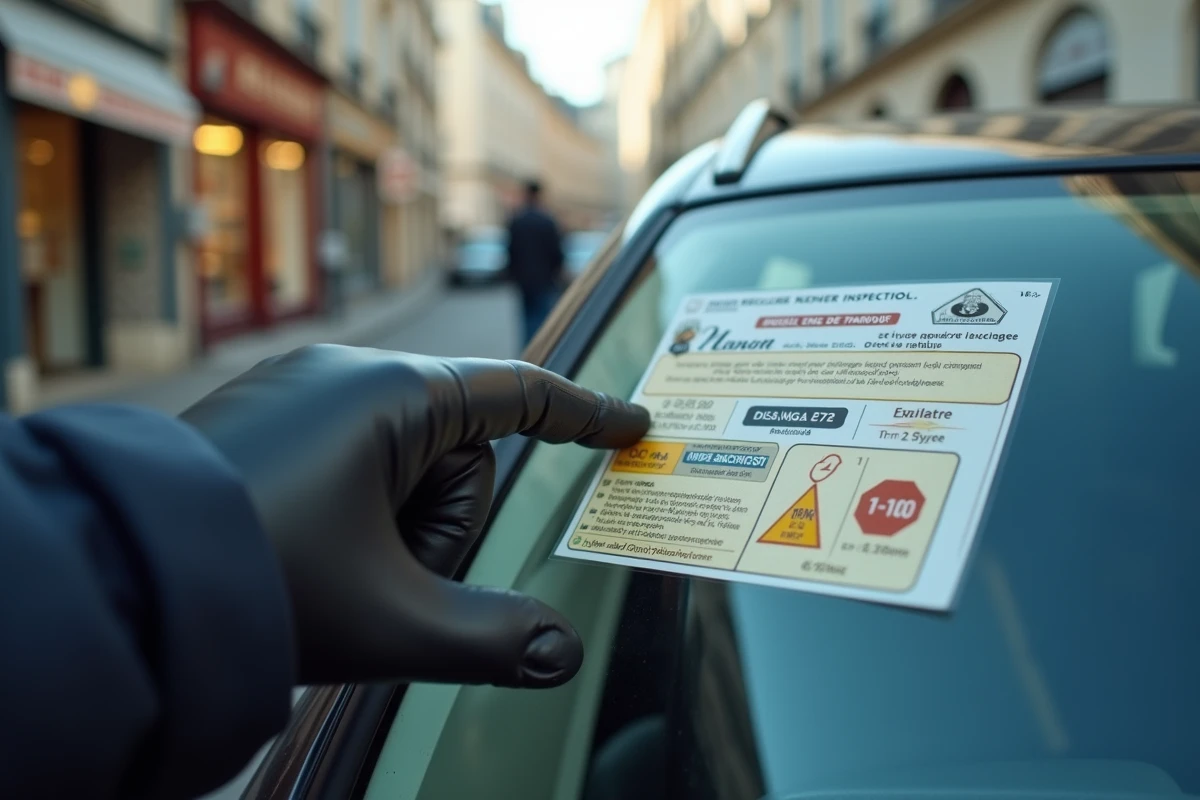
Visual Inspection of the Vehicle: What the Police Check Beyond the Sticker
The digital consultation does not exempt officers from a physical examination of the vehicle. During a roadside check, police officers and gendarmes increasingly conduct a visual inspection of the overall condition: tires, lighting, safety equipment, apparent condition of the bodywork.
One point deserves to be emphasized. Even if the technical inspection is theoretically up to date, law enforcement can decide to immobilize a vehicle on the spot if there are serious doubts about its safety. The legal obligation to maintain the vehicle in “good working order” and “in satisfactory condition” remains enforceable regardless of the validity of the technical inspection.
In other words, a valid technical inspection does not protect against immobilization if the actual condition of the vehicle poses a clear danger. A worn tire or a malfunctioning brake light observed on-site is enough to justify an immediate decision, regardless of the result of the last inspection at an approved center.
Sanctions and Immobilization During a Roadside Check
Driving without a valid technical inspection, whether the validity date has expired or a follow-up visit has not been completed within two months, exposes the owner to a fixed fine of 135 euros. This fourth-class offense is not limited to a simple financial penalty.
The possible consequences go further:
- The retention of the registration certificate by law enforcement, with the issuance of a provisional circulation document requiring the technical inspection and any necessary repairs to be completed within seven days.
- The immobilization of the vehicle on-site if its condition is deemed dangerous, regardless of the status of the technical inspection.
- The towing of the vehicle in the most serious cases, particularly in the event of recidivism or accumulation of offenses (such as lack of insurance).
These checks are often combined with targeted operations. Law enforcement regularly organizes group checks on identified routes, where insurance, technical inspection, and vehicle condition are checked simultaneously.
Manufacturer Recalls and Technical Inspections: The December 2025 Decree
Decree No. 2025-1180 of December 8, 2025, introduced a notable change. Serious recalls declared by manufacturers are now included in the scope of the technical inspection. A vehicle subject to an unresolved safety recall may be assigned a failure during its visit to an approved center.
This development has a direct consequence on police checks. If a serious recall is in the vehicle’s electronic file and the owner has not addressed it, the technical inspection may be considered non-compliant, even if the validity date has not expired. Field reports vary on the actual frequency of these checks by law enforcement, as the deployment of this feature in consultation tools is still recent.

Limitations of the Current System
The technical inspection remains an examination conducted without disassembly, at a given moment. It does not guarantee the condition of the vehicle between two visits. Law enforcement, even equipped with efficient digital tools, does not have data on the actual wear of mechanical parts at the time of the roadside check.
The reliability of the system thus relies on two complementary pillars: the centralized database for administrative validity, and the officer’s visual assessment for actual condition. Neither replaces the other, and the owner’s responsibility to maintain their vehicle in good condition remains the legal foundation upon which all sanctions are based.