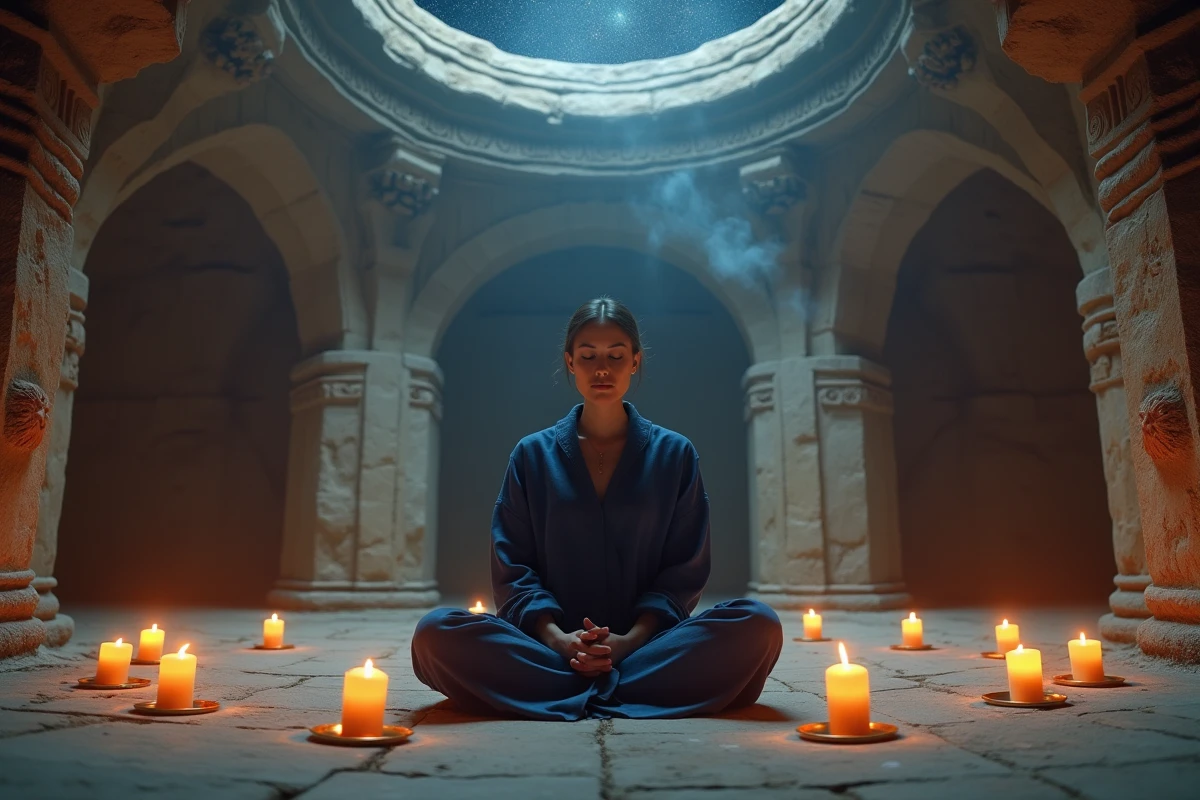
The number seven crosses spiritual traditions, ancient cosmologies, and symbolic systems without any culture seeming to be able to do without it. From the seven heavens of Islamic tradition to the seven chakras of tantric yoga, this recurrence raises questions. Behind the idea of “seven spiritual worlds” lies an assembly of correspondences between planes of existence, levels of consciousness, and dimensions of daily experience.
Correspondences between seven chakras, seven subtle bodies, and seven worlds
Most of the content available online treats the seven chakras, the seven subtle bodies, or the seven dimensions of well-being separately. None propose a systematic correspondence between these different systems of seven, while the parallelization forms the foundation of many contemporary teachings.
In Anglo-Saxon spiritual circles, each “world” or plane is associated with a specific chakra and a subtle body (physical, etheric, astral, mental, causal, buddhic, atmic). The guiding idea: each world influences a specific level of life (physical, emotional, mental, social, spiritual, vocational, environmental). This framework allows those who use it to locate a perceived imbalance within a particular plane.
An article detailing the 7 spiritual worlds on 100 Pour 100 Annonces revisits this mapping and its symbolic implications. The difficulty lies in the fact that these correspondences vary according to the schools: a reiki practitioner will not overlay the same attributes as a theosophy follower on the third or fifth plane.

Symbolism of the number seven in mystical traditions
The seven did not wait for the New Age to structure humanity’s narratives. The Hebrew tradition counts seven days of creation. Islam describes seven superimposed heavens. Buddhism mentions the seven steps of the Buddha at his birth. The seven functions as an organizing archetype, a framework that allows for sequencing an initiatory journey or inner progression.
Teresa of Avila, in the 16th century, formalized seven “mansions” in her Interior Castle, describing the mystical life as a journey from the porch (first mansions) to spiritual marriage (seventh mansion). This structure is not anecdotal: it has influenced centuries of Christian spiritual direction and remains studied today.
Deepak Chopra, in The Seven Spiritual Laws of Success, adopts this sequential logic by applying it to personal development. The Law of Pure Potentiality, the Law of Least Effort, the Law of Dharma: each step assumes that the previous one has been integrated. The model of the seven spiritual worlds operates under the same mechanism, regardless of the doctrinal corpus.
Why seven and not another number
The available data do not allow for a conclusion on a single reason. Some authors suggest a link with natural cycles (lunar phases divided into quarters of seven days). Others point to the human cognitive ability to retain about seven elements simultaneously, making this number naturally suited for classification systems.
Field reports diverge on this point: for some practitioners, the seven has an intrinsic, almost vibrational value. For others, it is a cultural convention that has become universal through the accumulation of cross-references.
Growing demand for practical readings of spiritual planes
In recent years, practitioners (spiritual coaches, energy therapists, meditation circles) have reported an increase in demand for personalized readings of spiritual worlds. Energy assessments, so-called “karmic” diagnostics, initiation paths in seven steps: the offerings have diversified and structured around this framework.
The phenomenon goes beyond mere fleeting enthusiasm. It fits into a broader context where individual quests for meaning borrow ancient symbolic frameworks to organize self-work. The model of the seven worlds then serves as a progression map, each plane corresponding to a domain of attention:
- The physical plane, associated with the first chakra, concerns grounding, bodily health, and the relationship to matter
- The emotional and mental planes, linked to the second and third levels, touch on the management of feelings and clarity of thought
- The higher planes (from the fourth to the seventh) are associated with heart opening, intuition, spiritual vision, and connection to a broader consciousness
This segmentation has the merit of making concrete a discourse that would otherwise remain abstract. However, it raises a fundamental question: the mapping is neither verifiable nor falsifiable, which places it outside the scientific field and brings it closer to a tool for meditation or visualization.
Limits and points of caution regarding the systems of seven worlds
The attraction to the seven spiritual worlds does not come without pitfalls. The first concerns excessive standardization. Applying a single grid of seven levels to traditions as different as Sufism, yoga, and Kabbalah amounts to erasing centuries of doctrinal context. The correspondences are appealing due to their symmetry, but they simplify systems that do not always overlap.
The second point relates to the commercial offering. The proliferation of “karmic diagnostics” and seven-step energy assessments responds to a demand, but no regulatory framework governs these practices in France. The title of “energy therapist” or “spiritual coach” does not correspond to any state-recognized diploma.
The third concerns the confusion between symbolism and prescription. A system of seven worlds can serve as a support for personal reflection, a meditation grid, or a common language within a practice group. It does not constitute a medical diagnosis or a substitute for qualified psychological support.
- Verify the training and references of any practitioner offering work on “spiritual planes”
- Distinguish between symbolic use (meditation, introspection) and prescriptive use (diagnosis, treatment)
- Keep in mind that the richness of the model lies in its poetic and contemplative dimension, not in its predictive value
The model of the seven spiritual worlds remains one framework of thought among others. Its longevity across cultures testifies to a capacity to structure inner experience. Its relevance depends less on its “objective truth” than on how it is used: as a tool for lucid contemplation or as a grid imposed without discernment.