
Mikado Racing primarily lists spare parts and equipment, with a more limited catalog of complete cars than one might expect. This positioning requires a specific search method to isolate a usable competition chassis, far from the general navigation offered by traditional classifieds.
Check FIA regulatory compliance before contacting a seller
An attractive mechanical listing can become unusable if the homologation does not correspond to the targeted season. The FIA publishes updated technical documents, and categories evolve regularly. A seat compliant with the FIA 8855-2021 standard is not sufficient if the regulations of the targeted discipline have changed in the meantime.
We recommend downloading the technical regulations of the considered category (regional rally, hill climb, circuit) even before browsing the listings. Comparing each item listed in the seller’s description with the current requirements helps avoid discovering a compliance issue after the transaction.
Harnesses, fire extinguishers, and fuel tanks have expiration dates. On Mikado Racing, serious sellers now specify these deadlines in their descriptions. If the listing does not mention the validity of the safety equipment, it is a warning sign: always request the homologation dates in writing.
To learn everything about Mikado Racing and how it works, keep in mind that the platform acts as a listing site, not as a secure intermediary. No escrow, no guarantee of compliance. Technical and contractual verification remains entirely the buyer’s responsibility.
Verified Pro Label on Mikado Racing: what it actually covers
The “Verified Pro” badge reassures at first glance, but its scope is limited. It relies on the verification of the seller’s SIREN number. Nothing more. This label does not validate the mechanical condition of the vehicle, its competition history, or its compliance with a given sports category.

In practice, a professional can display this badge and sell a chassis whose roll cage no longer meets standards or whose engine has undergone undocumented modifications. We observe that this confusion between commercial credibility and technical certification regularly traps buyers who are new to competition.
Before committing, demand the following documents directly from the seller:
- The vehicle’s technical passport (or homologation sheet), indicating the category and validity date
- Invoices for the revision of safety elements (harness, extinguisher, roll cage) with their expiration dates
- The competition history: number of seasons, type of events, engine mileage since the last major revision
- The certificate of conformity if the vehicle has been modified from its original homologation sheet
A seller who refuses to provide these documents or who systematically delays the request does not deserve your time, regardless of the displayed price.
Race car and road use: a frequent incompatibility
One point that listings often overlook: a competition car is not automatically usable on the road. The removal of the catalytic converter, the installation of a non-homologated roll cage, the absence of compliant lights, or the removal of the airbag render the vehicle unfit for standard registration.
If your project includes trips between home and the track without using a transport trailer, check that the vehicle still has a valid registration document and that the modifications made are compatible with the technical inspection. Some rally preparations maintain a dual road/competition configuration, but this versatility is becoming rarer on heavily modified chassis.
For vehicles deregistered from the registration system, bringing them back into compliance can cost as much as the competition preparation itself. We recommend clarifying this point as early as the first exchange with the seller.
Filter Mikado Racing listings by discipline and realistic budget
The platform allows sorting by category (rally, circuit, hill climb, historic), but the volume of complete car listings remains modest compared to spare parts. This reality requires broadening your search over several weeks rather than hoping to find the right chassis in one session.
The purchase budget represents only a fraction of the actual cost. Before setting a ceiling, include the following items:
- Bringing expired safety equipment back into compliance (harness, extinguisher, seat)
- Entry fees for the season (licenses, event registrations, competition insurance)
- Transport of the vehicle if the registration document is deregistered or if the chassis is not operational
- Engine and gearbox revision if the competition mileage exceeds the threshold recommended by the original preparer
An attractively priced listing may hide several thousand euros of upgrades. The cost of the first season often exceeds the purchase price of the vehicle, especially in regional rally where additional expenses accumulate quickly.
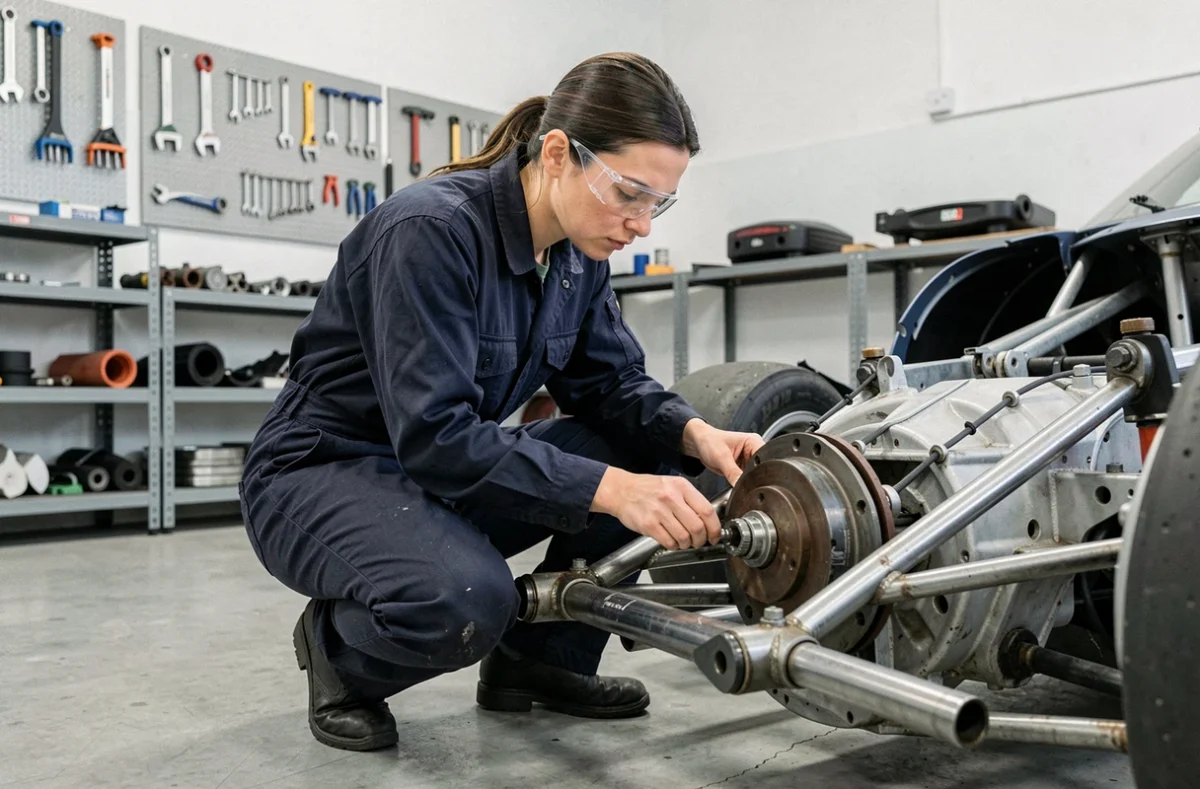
Competition spare parts on Mikado Racing: a deeper catalog than cars
The platform’s offerings lean heavily towards components: running gear, body elements, prepared engines, short transmissions. For a driver who already owns a chassis and seeks to improve performance, Mikado Racing proves more useful than for someone starting from scratch.
Cross-referencing parts listings with the specifications of your category’s technical regulations allows you to spot concrete opportunities. A shock absorber homologated for a given category, sold by a team changing disciplines, often represents a better value than a new component ordered from the manufacturer.
The downside: no guarantee of functionality is provided by the platform. Each transaction remains a direct agreement between individuals or professionals. Always request dated photos, usage mileage, and, for engine parts, the compression or wear readings if available.
The second-hand racing car market relies on the buyer’s diligence, not on the safety nets of the platform. Mikado Racing provides the showcase, but verifying listings, regulatory compliance, and negotiation remain your responsibility at every step.